Why Noctilucent Clouds Are Rare Atmospheric Wonders
Noctilucent clouds are elusive phenomena that grace the twilight sky. Learn the unique conditions required for these electric blue displays to form in the upper atmosphere.
Noctilucent Clouds Are Rare Atmospheric Wonders
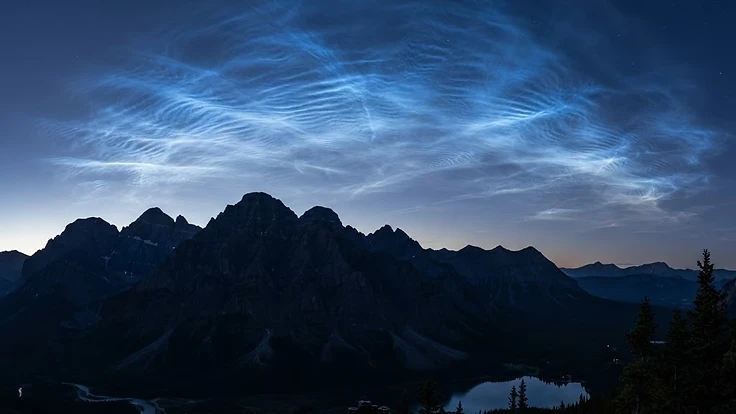
Noctilucent clouds are among the most ethereal spectacles in our night sky. Appearing as glowing, electric blue filaments against the dark twilight, they remain one of the few high-altitude phenomena visible to the naked eye. Unlike the [science and wonder of the aurora borealis](/blog/the-science-and-wonder-of-the-aurora-borealis) which relies on geomagnetic activity, these clouds are a purely meteorological event occurring in the extreme reaches of our atmosphere.
Their rarity is not merely a matter of chance. It is the result of an incredibly specific set of environmental requirements that align only during certain seasons and latitudes. While we often focus on the influence of space weather and sunspots and their role in shaping space weather, understanding these clouds offers a unique look at the cooling layers of our own planet.
The Science Behind It
Noctilucent clouds, or polar mesospheric clouds, form at the staggering altitude of 80 kilometres above the Earth. This is well into the mesosphere, far above the weather patterns we experience on the ground. At this height, the air is unimaginably dry, yet they require the presence of tiny ice crystals to become visible to observers below.
These clouds depend on the presence of meteoric dust which acts as a seed for water vapour to condense upon. As tiny dust particles from space drift down into the atmosphere, they provide the necessary surface for water molecules to freeze. This process can only occur when temperatures in the mesosphere drop to below minus 120 degrees Celsius, a condition usually met only during the summer months near the poles.
Real-World Implications
While they are beautiful, these clouds serve as a critical indicator of atmospheric health. Because they form in such a sensitive layer of the sky, they are highly responsive to changes in greenhouse gases and global temperature patterns. Their increasing frequency in recent decades has provided researchers with a way to track long term shifts in the upper atmosphere.
They do not directly impact human infrastructure like a significant [geomagnetic storm](/ #kp) or a massive solar flare might. However, they serve as a reminder of how interconnected our atmosphere is with the space environment above us. By studying them, scientists gain a better understanding of how the Earth reacts to external radiation and climate forcing over long periods.
What You Can Do
If you want to spot these rare clouds, you must be patient and know your local horizon. They are most commonly seen during the deep twilight hours when the sun is between 6 and 16 degrees below the horizon. If you are travelling to high northern or southern latitudes, your chances of seeing them increase significantly during the summer solstice period.
For those chasing the light, it is often helpful to understand the broader space environment. Even when the sky is clear of noctilucent clouds, you might observe an [aurora](/ #aurora) if the solar wind is active. If you are planning an expedition to catch these wonders, there are many guided aurora tours in countries like Sweden, Iceland, and Canada that can help you navigate the best viewing spots.
Key Takeaways
Noctilucent clouds remain a testament to the quiet complexity of our upper atmosphere. They represent a rare intersection where space dust, extreme cold, and water vapour meet in the high reaches of the sky. While they are not as frequent as other atmospheric displays, their presence provides invaluable data on how our climate is changing.
Keep your eyes on the horizon during the twilight hours of the summer season. Whether you are watching for these clouds or keeping an eye on the [local aurora forecast](/ #local) to see if the night sky will light up, there is always something worth observing. These clouds remind us that the sky above is a dynamic and changing environment.
People Also Ask
How high do noctilucent clouds form?+
Noctilucent clouds form at an altitude of approximately 80 kilometres above the Earth's surface. This puts them in the mesosphere, which is the coldest layer of our atmosphere. At this extreme height, the clouds are able to catch sunlight even when the ground is in darkness.
Why are noctilucent clouds blue?+
These clouds appear blue because they are made of tiny ice crystals that scatter sunlight. Their structure preferentially scatters shorter, blue wavelengths of light. When the sun is below the horizon, this specific scattering effect makes the clouds stand out as electric blue streaks against the twilight sky.
Can you see noctilucent clouds during the day?+
Noctilucent clouds are generally not visible during the day because they are too thin and faint to be seen against the bright glare of the sun. They require the contrast of a dark twilight sky to become visible, which is why they are typically observed just after sunset or before sunrise.
Continue Reading
Forecast These Questions
View all →Express your probability on these active forecast questions.