The Cosmic Origins of Asteroids
Asteroids are the rocky remnants of our solar system's birth. Discover where these celestial objects originate and why they remain essential to understanding our history.
The Cosmic Origins of Asteroids
Asteroids are far more than chaotic rocks hurtling through the dark void. They are the frozen archives of our solar system, dating back over four billion years to the turbulent era of planetary formation.
Near-Earth Asteroid Watch
Powered by Flarient — embed this on your site →
Most of these celestial bodies inhabit the space between Mars and Jupiter. By studying their composition, scientists gain direct insight into the raw materials that eventually coalesced to form the Earth itself.
The Science Behind It
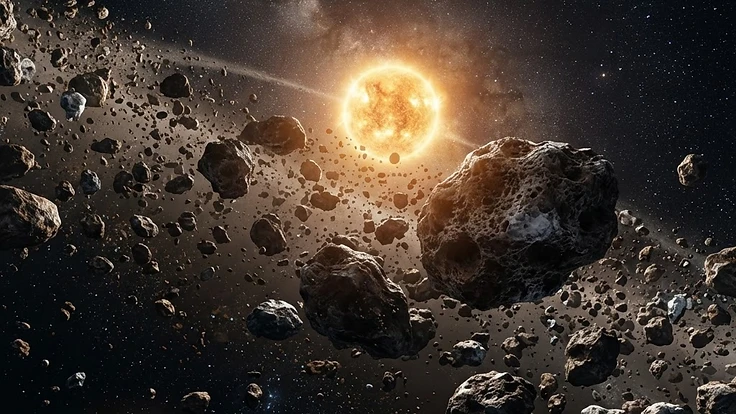
The vast majority of asteroids reside within the main belt, a sprawling region containing millions of individual objects. This collection of debris never managed to form a planet due to the immense gravitational influence of Jupiter.
Over time, Jupiter tugged at these objects and prevented them from accumulating enough mass to settle into a stable planetary orbit. This left behind a massive ring of rocky material that orbits the sun in a predictable path.
Beyond the main belt, smaller populations exist, including those classified as a near-Earth asteroid which occasionally cross our path. These objects often arrive in the inner solar system after being nudged by gravitational interactions.
Collisions between larger bodies within the main belt often eject smaller fragments into eccentric orbits. These fragments continue to travel until they are either recaptured or drift into new zones of space.
Real-World Implications
Understanding the distribution and movement of asteroids is critical for long term planetary defence. While the vast majority pose no risk, tracking these objects helps us model future trajectories with high precision.
Space agencies use ground based telescopes and orbiting observatories to build comprehensive catalogues of these rocky visitors. This process helps us refine our knowledge of orbital dynamics, as discussed in our detailed guide on [the orbital mechanics governing asteroid motion in space](/blog/the-orbital-mechanics-governing-asteroid-motion-in-space).
Beyond safety, asteroids represent a potential resource for future space exploration missions. They are rich in minerals and volatile compounds that could sustain long duration travel between planets.
What You Can Do
Public interest in space science helps support the continued funding of planetary tracking programmes. You can stay informed by monitoring official data releases from NASA CNEOS, which provides regular updates on close approaches.
If you want to track space activity from your own computer, consider using our embeddable widgets to display current orbital data on your own website. These tools are designed to make complex space data accessible to everyone.
You might also find it useful to check our glossary if you encounter technical terms in news reports about celestial encounters. Staying educated is the best way to separate scientific reality from sensationalist headlines.
Key Takeaways
Asteroids serve as a window into the dawn of the solar system. Their origins lie in the leftover building blocks of the early planets, kept in stasis for eons by the gravitational pull of Jupiter.
By tracking these objects, we improve our collective ability to protect the planet and prepare for future exploration. The more we observe, the better we understand our place in the wider cosmic neighbourhood.
People Also Ask
Can asteroids hit the Earth?+
Yes, asteroids can strike Earth, but significant impacts are extremely rare. Scientists track thousands of near-Earth objects to predict their paths centuries in advance, and NASA maintains a comprehensive system to monitor any potential risks posed by space rocks crossing our orbit.
What is the difference between an asteroid and a meteor?+
An asteroid is a large, rocky body orbiting the sun, primarily found in the main belt. A meteor is the streak of light produced when a smaller piece of space debris, known as a meteoroid, enters Earth's atmosphere and burns up due to friction.
Are all asteroids found in the asteroid belt?+
No, while the majority of asteroids are located in the main belt between Mars and Jupiter, others exist throughout the solar system. Some share orbits with planets, while others, known as near-Earth objects, occupy paths that bring them into the inner solar system.
Continue Reading
Forecast These Questions
View all →Express your probability on these active forecast questions.