The Cosmic Scale of Asteroids Versus Earth
Can asteroids truly grow larger than our planet? Understanding the physical boundaries of solar system objects reveals why Earth remains a unique class of planetary body.
The Cosmic Scale of Asteroids Versus Earth
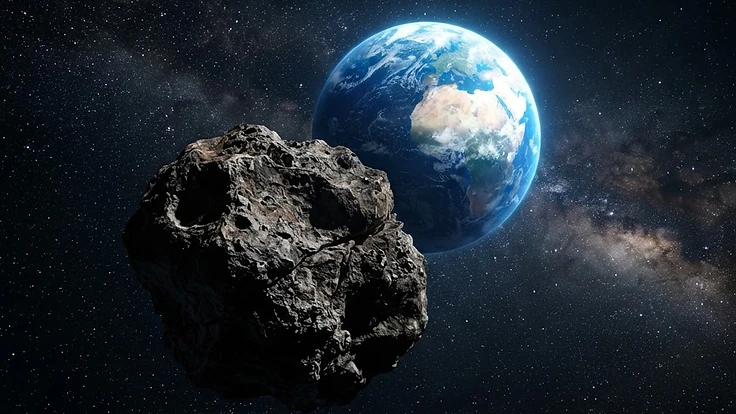
When we gaze at the night sky, it is tempting to imagine colossal rocks drifting through the void, perhaps larger than our own home. The reality of celestial mechanics, however, tells a more structured story. While asteroids exist in vast numbers, they possess fundamental physical limits that prevent them from ever rivalling the scale of Earth.
Near-Earth Asteroid Watch
Powered by Flarient — embed this on your site →
Understanding these limits requires looking at how planetary bodies form. Large objects like Earth achieved enough mass to pull themselves into a spherical shape under their own gravity, clearing their orbits of debris. Asteroids, by contrast, are the leftover building blocks of the solar system, lacking the mass necessary to achieve hydrostatic equilibrium.
The Science Behind It
Asteroids are defined by their status as minor planets. The largest objects in the asteroid belt, such as Ceres, are spherical because they contain enough mass to be considered dwarf planets, but they still remain significantly smaller than our planet. Ceres, for instance, has a diameter of less than 1,000 kilometres, compared to Earth's equatorial diameter of nearly 12,742 kilometres.
Physics prevents an asteroid from growing to the size of Earth within its current environment. If a body reaches a certain mass, it naturally differentiates, forming a core, mantle, and crust, eventually evolving into a planet or a moon. Asteroids generally remain as fragmented, irregular bodies because they never accumulated enough material to complete this process.
Even when we look at a near-Earth asteroid, we are dealing with objects that are minuscule compared to a planet. Massive impacts, such as the Chicxulub asteroid, which was roughly 10 kilometres wide, caused global devastation 66 million years ago.
Despite that immense destructive power, that rock was an atom in the grand scale of planetary mass.
Real-World Implications
Our modern infrastructure relies on a precise understanding of these space rocks. While we do not fear an asteroid larger than Earth, smaller objects pose risks to satellite networks and global communication systems. A large impact would alter our climate, but scientists are currently tracking known threats through programmes like the NASA CNEOS monitoring system to ensure early detection.
Beyond impacts, these objects provide clues about the history of our solar system. You can explore more about their formation in our guide on The Formation and Evolution of Asteroids.
Understanding these bodies is critical, just as we monitor how solar flares influence global power grid stability during the current solar cycle.
What You Can Do
Stay informed by using resources that track space activity in real time. Our platform allows you to monitor near-Earth asteroid paths alongside other solar phenomena that might affect our technological environment. Whether you are a researcher or an enthusiast, having access to accurate, live data is the best way to separate scientific fact from common myths.
You can even embeddable widgets on your own website to share this live data with your community. Keeping track of the solar wind and potential space hazards helps demystify the vast, active environment we inhabit. Always cross-reference information with official sources like ESA Space Weather to ensure you are relying on vetted, peer-reviewed data.
Key Takeaways
Asteroids will never be larger than Earth because the physics of planet formation mandates a transition into a spherical, differentiated body long before reaching planetary size. While they are not rivals to our planet in scale, they remain significant objects for scientific study and planetary defence.
By keeping an eye on the sky, we learn more about our place in the universe. Whether monitoring potential impacts or tracking the solar cycle, constant learning remains the best tool at our disposal. Explore our glossary to learn more about the terminology scientists use to describe these fascinating celestial travellers.
People Also Ask
What is the largest known asteroid?+
Ceres is officially classified as the largest object in the asteroid belt. With a diameter of approximately 940 kilometres, it is so large that it is considered a dwarf planet rather than a typical asteroid, though it remains far smaller than the Moon or Earth.
Could an asteroid ever collide with Earth?+
Yes, asteroid collisions are a natural part of solar system history. Earth is struck by small objects frequently, though large, dangerous asteroids are tracked by space agencies. NASA and ESA monitor near-Earth objects to provide long-term warnings for any asteroid that could potentially pose a hazard to our planet.
What makes a planet different from an asteroid?+
A planet must be massive enough for its gravity to pull it into a round shape and must have cleared its orbit of other debris. Asteroids are smaller, irregular, and lack the gravity to become spherical. They are essentially leftover building blocks from the early formation of the solar system.
Continue Reading
Forecast These Questions
View all →Express your probability on these active forecast questions.
Will a near-Earth object pass within 1 Lunar Distance this quarter?
35%
Community
Will a near-Earth object pass within 1 Lunar Distance this quarter?
35%
Community
Will a newly discovered asteroid larger than 10m pass within 5 LD this month?
35%
Community
Will a near-Earth object pass within 5 Lunar Distances this month?
45%
Community