The Economic and Scientific Potential of Asteroid Mining
Asteroid mining is moving from the realm of science fiction to a tangible future industry. We explore the physics, resource potential, and the reality of extracting materials from space.
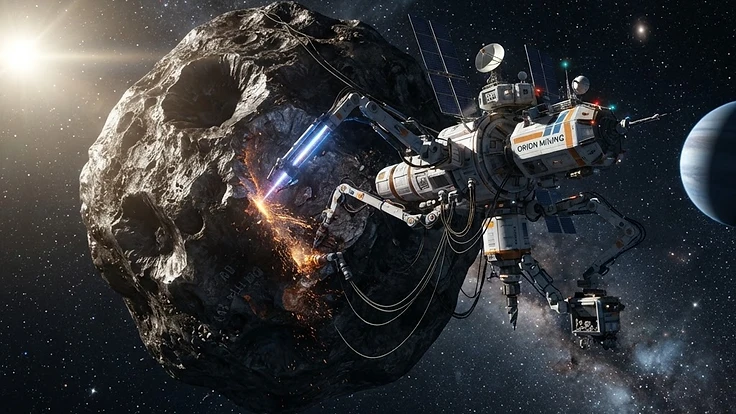
Asteroid Mining Represents a Future Resource Frontier
The scarcity of rare earth metals and volatile compounds on Earth has led scientists and engineers to look upwards. Asteroids, the remnants of our solar system formation, contain vast quantities of iron, nickel, platinum, and water ice. Mining these celestial bodies could fundamentally change our space economy.
Near-Earth Asteroid Watch
Powered by Flarient — embed this on your site →
While the concept may sound futuristic, the technological groundwork is being laid today. Companies are analysing how to capture these near-Earth asteroid objects for resource extraction. This shift marks a transition from exploration for discovery to exploration for industrial utility.
The Science Behind It
Asteroids are essentially giant rubble piles or solid masses of rock and metal drifting through space. They vary in composition, with C-type asteroids being carbon-rich and M-type being metallic. Extracting resources requires precise navigation to meet a target moving at thousands of kilometres per hour.
Once a spacecraft arrives, the mining process involves thermal mining or mechanical excavation. For water-rich asteroids, the ice can be heated to create liquid water, which is then split into hydrogen and oxygen for rocket propellant. This creates a refuelling depot in orbit, lowering the cost of deep-space travel significantly.
Real-World Implications
If we successfully tap into these resources, the global reliance on Earth-based mining would decrease. We could manufacture large structures in space, using materials sourced from the asteroid belt rather than launching them from the surface. This approach reduces the mass needed for heavy lift rockets.
Furthermore, the cosmic origins and formation of asteroids provide clues to the history of the solar system. By analysing these materials in-situ, we refine our understanding of planetary evolution. It is a dual benefit of scientific advancement and economic growth.
What You Can Do
Staying informed about space conditions is vital as we move toward an era of orbital industrialisation. Keeping track of solar activity is necessary because space weather can affect the sensors and navigation systems used by mining probes. You can monitor live solar data via the Flarient dashboard to see how current conditions might impact long-term space missions.
If you are interested in the wider context of space exploration, explore our glossary to learn about the terminology used by engineers. Being familiar with these metrics allows you to better interpret data from NASA CNEOS regarding potential mining targets.
Engaging with these resources makes the complex world of space mining more accessible.
Key Takeaways
Asteroid mining offers a solution to resource depletion while serving as a stepping stone for human expansion into the solar system. The technology required to extract, process, and utilise these materials is under active development. Our success in this endeavour depends on our ability to manage the risks and logistical hurdles of space travel.
By keeping an eye on advancements and understanding the role of space weather in orbital operations, we prepare for a future where the resources of the cosmos are within reach. It is a long-term goal, but one that promises to reshape our technological capabilities for generations to come.
People Also Ask
What materials can be mined from asteroids?+
Asteroids contain valuable resources including water ice, which is critical for fuel, and metals such as iron, nickel, and cobalt. Some asteroids also contain platinum-group metals, which are rare and highly expensive on Earth, making them targets for future commercial space mining ventures.
How do we land on an asteroid?+
Landing on an asteroid is difficult because they often have very low gravity. Spacecraft use a process called touch-and-go, where they descend briefly to the surface to collect samples or attach mechanisms before firing thrusters to move away, ensuring they do not drift into space.
Why is asteroid mining considered expensive?+
The primary cost is the high price of launching heavy machinery into space. Additionally, navigating to a moving target, maintaining communication across vast distances, and developing robotics capable of autonomous operation in extreme thermal environments require significant investment and years of research and testing.
Continue Reading
Forecast These Questions
View all →Express your probability on these active forecast questions.
Will a near-Earth object pass within 1 Lunar Distance this quarter?
35%
Community
Will a newly discovered asteroid larger than 10m pass within 5 LD this month?
5%
Community
Will a near-Earth object pass within 1 Lunar Distance this quarter?
35%
Community
Will a near-Earth object pass within 5 Lunar Distances this month?
5%
Community