The Kessler Syndrome and the Future of Earth Orbit
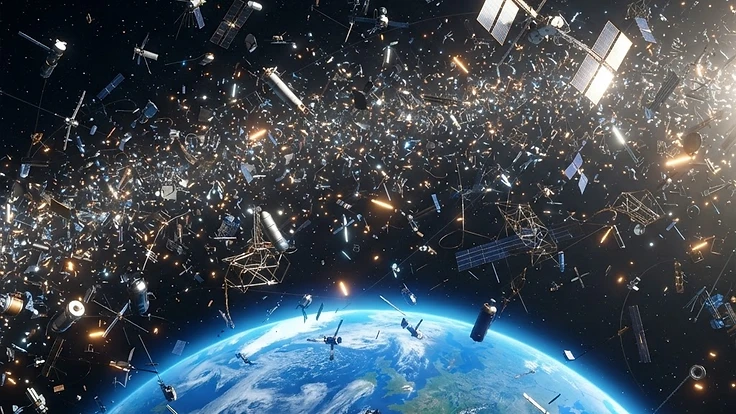
The Kessler Syndrome describes a scenario where orbital debris creates a cascading chain reaction of collisions, potentially rendering low Earth orbit unusable for future generations.
The Kessler Syndrome and the Future of Earth Orbit
Humanity relies heavily on satellites for global communication, navigation, and environmental monitoring. Yet, the region just above the Kármán line is becoming increasingly crowded with defunct hardware and fragments from previous missions. This accumulation of orbital debris leads to the Kessler Syndrome, a theoretical but scientifically grounded chain reaction where collisions create more fragments, which in turn cause further impacts.
If left unchecked, this process could effectively seal Earth behind a wall of high speed shrapnel.
The Science Behind It
The Kessler Syndrome is named after Donald Kessler, a NASA scientist who first modelled this phenomenon in 1978. At orbital velocities of roughly seven kilometres per second, even a tiny bolt carries the kinetic energy of a hand grenade. When two objects collide, they break into thousands of smaller pieces, each capable of causing subsequent destruction.
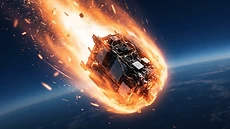
This cascading effect is particularly dangerous because objects in low Earth orbit, such as the ISS, cannot simply manoeuvre away from millions of microscopic particles. Once the density of debris reaches a critical threshold, the rate of new collisions may exceed the rate at which fragments naturally de-orbit due to atmospheric drag. Understanding the complexities of satellite reentry and the physics of orbital decay is therefore vital for those tracking space traffic.
Real-World Implications
The threat is not limited to the loss of expensive hardware. Our modern reliance on GPS, weather forecasting, and international finance depends on a stable and accessible orbital environment. A severe debris cloud could disrupt these critical services for years, forcing industries to navigate a much harsher operating environment.
Furthermore, the challenge of managing space traffic is largely a matter of international responsibility for the management of orbital debris. Without clear regulations and active removal technologies, we risk losing access to the very space that enables global connectivity. This situation parallels other hazards, such as a near-Earth asteroid encounter, where the sheer scale of the potential impact necessitates proactive monitoring and global cooperation.
What You Can Do
Staying informed is the best way to understand the evolving state of our near-space environment. You can monitor active space weather, which occasionally influences the density of the upper atmosphere and affects how fast debris decays, by using the resources found in our glossary. By keeping an eye on historical trends through our archive, you gain perspective on how humanity has handled orbital challenges in the past.
Educating yourself on the broader context of space sustainability is equally important. Whether you are an enthusiast or a professional, you can share this knowledge by using our embeddable widgets on your own site to display live data. Understanding the environment above us is the first step in ensuring that space remains a viable frontier for scientific discovery and commercial progress.
Key Takeaways
The Kessler Syndrome serves as a stark reminder of our environmental impact on the space surrounding Earth. While the situation is concerning, it remains manageable through strict international cooperation and the development of debris mitigation technologies. By prioritising sustainable orbital practices today, we prevent a future where access to space is restricted by our own waste.
We must treat the orbital environment with the same care we accord to our terrestrial resources. Maintaining the safety of the skies is not just an engineering requirement but a necessity for the modern world. With continued research and shared data, we can keep the path to the stars clear for those who follow.
People Also Ask
Can the Kessler Syndrome be reversed?+
Active debris removal is currently being researched by space agencies worldwide. While we cannot easily sweep space like a vacuum cleaner, technologies designed to capture and de-orbit large defunct satellites can prevent future fragmentation events and help stabilise the environment before a critical cascading reaction occurs.
How fast does orbital debris travel?+
Objects in low Earth orbit move at incredible speeds, typically around 7 to 8 kilometres per second, or about 28,000 kilometres per hour. At these extreme velocities, even a fragment the size of a paint chip carries enough kinetic energy to cause significant damage to functional spacecraft and satellite arrays.
Does atmospheric drag help clear space debris?+
Yes, atmospheric drag acts as a natural cleaning mechanism for low Earth orbit. Particles encounter thin upper-atmosphere gases that slow them down, causing their orbits to decay. However, this process takes years or decades, making it ineffective for preventing immediate collision risks posed by dense debris clouds.
Continue Reading
Forecast These Questions
View all →Express your probability on these active forecast questions.