The Physics Behind How Aurora Borealis Are Made
Discover how solar particles collide with our atmosphere to create the spectacular light shows known as the aurora borealis, a process governed by complex space weather.
The Mechanics of Atmospheric Light Shows
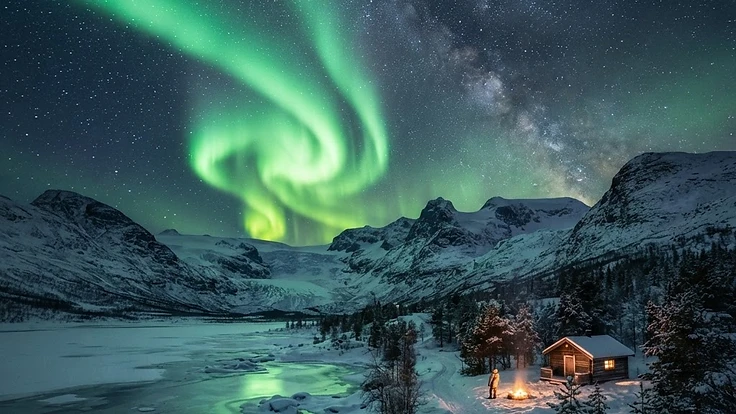
The aurora borealis serves as a visual bridge between the Sun and Earth. This phenomenon occurs when charged particles from the Sun interact with the magnetic environment surrounding our planet. It is not merely a display of colour, but a complex energy exchange that reveals the volatile nature of our solar neighbourhood.
Live Aurora Forecast
Powered by Flarient — embed this on your site →
Understanding how these lights form requires a look at the invisible forces that shield us. While we often focus on the beauty of the aurora, the science behind the scenes helps us appreciate the constant bombardment of cosmic energy that defines our place in space. Scientists rely on data from organisations like the NOAA SWPC to track the solar winds responsible for these displays.
The Science Behind It
The Sun constantly releases a stream of charged particles known as the solar wind. When these particles encounter Earth, our magnetic field acts as a protective barrier, funnelling them toward the poles.
As these particles travel at high velocities, they strike atoms in our upper atmosphere, primarily oxygen and nitrogen. This impact transfers energy to the atmospheric atoms, causing them to become excited.
When the atoms return to their original state, they release that excess energy as photons of light. The specific colours we see, such as green or red, depend on the type of gas being struck and the altitude of the collision.
This process is well documented in our glossary of space terms. It highlights the delicate balance between solar output and the planetary magnetic defence that makes life on Earth possible.
Real-World Implications
While the northern lights appear peaceful, the solar activity behind them can disrupt modern technology. When solar winds grow strong enough to cause a significant Kp index reading, the resulting geomagnetic currents can stress power grids and interfere with satellite communication.
High energy storms have the potential to degrade orbital tracking capabilities. You can learn more about these risks in our discussion on satellite protection systems against orbital debris.
Infrastructure providers must monitor these fluctuations to protect electrical transformers and maintain precision in GPS systems. Even if we cannot stop the Sun, we can adapt our systems to be more resilient against the intense energy of a solar cycle.
What You Can Do
Preparation is the best way to enjoy a display without missing the peak activity. You can track current conditions using local aurora forecast tools to see if visibility is high in your region.
If you are planning to witness the lights in person, consider booking guided aurora tours in destinations like Iceland, Norway, Canada, or Finland to maximise your chances. These experts provide local knowledge that is essential for remote stargazing.
We also provide embeddable widgets if you want to share real-time solar data on your own website. Staying informed helps transform a random observation into a planned scientific excursion.
Key Takeaways
The aurora is a beautiful byproduct of the Sun interacting with Earth. It reminds us that our planet is deeply connected to the broader dynamics of the solar system, ranging from near-Earth asteroid paths to solar flares.
By monitoring indices and weather patterns, we shift from passive observers to active participants in space science. Keep exploring our more articles to deepen your understanding of these celestial mechanics.
Nature provides us with a constant light show if we know where to look. With the right tools and knowledge, anyone can decode the signals sent across the void by our star.
People Also Ask
What causes the different colours in the aurora?+
The colours depend on which gas atoms are being excited and at what altitude. Oxygen at lower altitudes emits green light, while high-altitude oxygen produces red light. Nitrogen molecules typically generate blue or purple hues, depending on the energy level of the solar particles during the collision.
Are auroras visible from space?+
Yes, astronauts aboard the International Space Station, which orbits at approximately 408 kilometres, frequently observe the aurora from above. They see the lights as a glowing, wavy curtain circling the Earth's polar regions, providing a unique vantage point of the geomagnetic activity unfolding beneath them.
Does solar activity affect the aurora?+
Solar activity directly dictates the intensity of the aurora. During periods of high solar activity, such as near the peak of the 11-year solar cycle, more frequent solar flares and coronal mass ejections increase the number of charged particles hitting our atmosphere, leading to more frequent and intense displays.
Continue Reading
Forecast These Questions
View all →Express your probability on these active forecast questions.