The Physics of Asteroid Impact Tsunamis
Ocean impacts from asteroids present a unique geological threat. We analyse the mechanism behind these waves and why monitoring near-Earth objects remains a vital global priority.
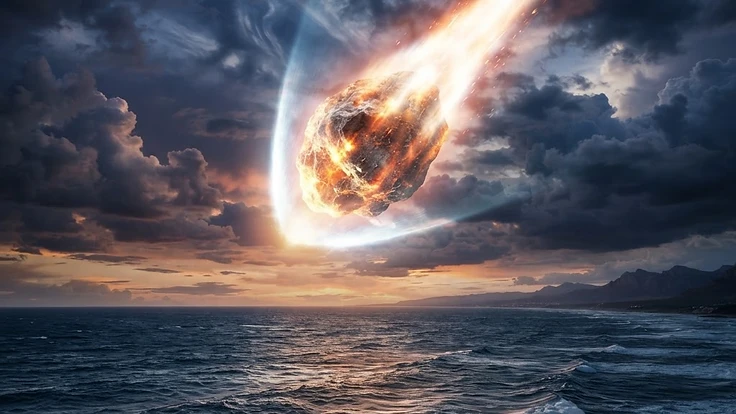
Asteroids Possess the Capability to Trigger Significant Tsunamis
The idea of an asteroid falling into the sea sounds like science fiction. However, the energy released by such an impact is a matter of pure physics, and water is an incredibly efficient medium for transferring that kinetic force into destructive waves.
Near-Earth Asteroid Watch
Powered by Flarient — embed this on your site →
Most of our planet is covered by water, meaning the odds of an impact occurring in the ocean are statistically much higher than a land strike. Understanding how these events function is key to realistic disaster modelling and planetary defence strategies.
The Science Behind It
When a large object strikes the ocean, it does not just make a splash. It displaces a massive volume of water, creating a crater in the sea surface that can be several kilometres deep.
As this cavity collapses, the water rushes back to fill the void, creating a series of powerful waves. Unlike earthquake-induced tsunamis that lift the entire sea floor, an impact tsunami is a sudden, high-energy event that radiates outward from the point of contact.
Energy transfer depends on the mass and velocity of the incoming object. An object like the Chicxulub asteroid, which was roughly 10 kilometres wide, would cause a global catastrophe, yet smaller bodies are far more common and could still cause localised, devastating surges.
Research indicates that even relatively small asteroids could displace enough water to pose a threat to coastal infrastructure. Scientists use complex simulations to estimate the wave height and reach of such events, relying on data from agencies like NASA CNEOS to categorise the risk levels of every known near-Earth asteroid.
Real-World Implications
Coastal communities are the most vulnerable, as they sit directly in the path of potential wave propagation. Infrastructure such as ports, energy plants, and shipping lanes would face immediate disruption from an impact scenario.
Beyond immediate physical destruction, such an event could lead to long-term economic instability. Global trade relies on the smooth operation of harbours and oceanic transport, all of which would halt in the face of a regional oceanic impact.
Our reliance on accurate tracking is paramount to mitigation efforts. When we monitor the trajectory of a near-Earth asteroid, we are effectively buying time for international space agencies to organise a redirection mission or coordinate civilian evacuations.
Data gathered from the archive of historical impacts helps researchers refine their models. By studying past events, we can better predict the behaviour of objects currently traversing our solar system.
What You Can Do
Public awareness is the first line of defence. Understanding the difference between a minor bolide and a dangerous object helps keep the threat in perspective, allowing us to focus on data rather than fear.
Individuals can keep track of ongoing research through official space weather and astronomy platforms. You can check the latest status of space objects on our dedicated asteroids page, which aggregates the latest detection data to help you stay informed about the local environment above our heads.
Being prepared involves knowing which organisations track these threats and how they communicate potential dangers. Engaging with space safety information is a responsible way to stay educated about the cosmic environment.
Key Takeaways
Asteroids cause tsunamis by transferring extreme kinetic energy into the ocean, resulting in complex, long-range waves. While large-scale impacts are rare, the frequency of smaller objects makes continued vigilance a necessity for human society.
We must continue to prioritise the detection and analysis of space bodies. Through scientific collaboration and clear communication, we can ensure that our planet remains prepared for whatever may come from the stars.
People Also Ask
How large does an asteroid need to be to cause a tsunami?+
While size is a major factor, an asteroid as small as 50 to 100 metres in diameter could create a significant local tsunami. The severity depends heavily on the impact velocity, the water depth at the impact site, and the distance to the nearest coastline.
How often do asteroid impacts happen?+
Small objects hit Earth's atmosphere daily, mostly burning up as meteors. Large impacts are incredibly rare. Scientists track objects through NASA CNEOS to identify any that could pose a threat, with no major impacts predicted for the foreseeable future.
Are there warning systems for asteroid tsunamis?+
Space agencies maintain constant watch over the sky to detect hazardous objects years or decades in advance. If a potential threat were identified, international protocols for planetary defence and emergency evacuation would be activated by governments and space authorities to protect coastal populations.
Continue Reading
Forecast These Questions
View all →Express your probability on these active forecast questions.