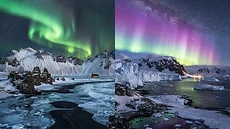
Daylight Aurora Visibility Is Rare but Possible
While usually associated with the dark night sky, the aurora can technically be visible during daylight under extreme conditions. We explore the physics behind this phenomenon.

Daylight Aurora Visibility Is Rare but Possible
Most observers associate the aurora with the dark, crisp skies of a winter night. The dancing curtains of light appear to require total darkness to resolve against the celestial backdrop. While true for the vast majority of sightings, physics does not forbid the phenomenon from occurring during the day.
Live Aurora Forecast
Powered by Flarient — embed this on your site →
Solar particles continue to rain down upon our atmosphere regardless of the sun position. When solar activity reaches extreme levels, the intensity of these light displays can occasionally compete with ambient daylight. Understanding how this happens requires a shift in perspective regarding how we define the night sky and the mechanics of planetary science.
The Science Behind It
The NOAA SWPC tracks geomagnetic activity using the Kp index, which measures magnetic disturbances on a scale from zero to nine.
A standard aurora display often occurs during moderate activity levels.
To witness an auroral event during daylight, the intensity must be significantly higher, typically associated with extreme geomagnetic storms.
These storms occur when solar wind, moving at speeds between 400 and 700 kilometres per second, interacts with the Earth magnetosphere. During intense events, like those that trigger a G5 rating on the G-scale, the energetic precipitation is so massive that the luminosity of the oxygen and nitrogen excitation can surpass the scattered light of the sun.
Essentially, the atmosphere is being bombarded by a high volume of charged particles. If the energy input is great enough, the emission spectral lines become bright enough to be detected by sensors. While the human eye struggles to resolve these against the bright daytime sky, they are objectively present.
Real-World Implications
Extreme geomagnetic storms are not just a matter of visual spectacle. Such high-energy events have profound consequences for our technological infrastructure. When the magnetosphere is heavily compressed, we see increased drag on satellites orbiting in low Earth orbit, affecting thousands of objects near the Kármán line.
These storms can induce electric currents in long-distance power grids, potentially causing voltage fluctuations or equipment damage. Communication systems, particularly those relying on high-frequency radio waves, often experience significant disruption as the ionosphere undergoes rapid changes. This is a common topic in studies on [what causes HF radio blackouts during solar flares](https://flarient.com/blog/what-causes-hf-radio-blackouts-during-solar-flares).
Modern society relies on a complex web of interconnected systems that are sensitive to space weather. Understanding the potential for auroral displays during daylight serves as a reminder of our vulnerability to these energetic solar events. Monitoring the storm leaderboard helps us track historical precedents and prepare for future disturbances.
What You Can Do
Preparation is the best defence against the unpredictability of space weather. You can monitor live data streams to stay informed about solar conditions before they impact local infrastructure. For those who enjoy chasing the lights, guided aurora tours in countries like Iceland, Norway, Canada, Finland, Sweden, and Alaska provide excellent opportunities to learn from experts who track these conditions daily.
Utilising local aurora forecast tools allows you to plan your observations more effectively. These resources pull from global satellite data to provide a clearer picture of when and where the auroral oval is active. You can even set up your own tracking displays by using embeddable widgets on your personal or professional site to keep your audience updated.
Staying informed means checking reliable sources regularly rather than waiting for a viral news report. By tracking the K-index in real time, you gain a better sense of the solar environment. This proactive approach turns complex space weather data into a manageable and exciting hobby.
Key Takeaways
Daylight aurora observations are the exception rather than the rule, requiring exceptionally high solar activity. While they remain difficult to see with the naked eye, the physical process remains constant throughout the day. These events remind us of our position on a planet bathed in a constant stream of solar radiation.
As we continue to rely more heavily on orbital assets, understanding these solar phenomena becomes increasingly critical for our daily operations. Whether you are an amateur astronomer or a curious observer, the key is to keep watching the sky. Staying curious about the physics of our universe helps us appreciate the rare moments when the veil between our world and space becomes thin.
People Also Ask
Does the aurora only happen at night?+
The aurora occurs whenever solar particles interact with the Earth atmosphere. It is a continuous physical process that happens during the day, but sunlight scatters so much light that the faint auroral glow is usually completely washed out and invisible to the human eye.
How intense must a storm be to see daylight aurora?+
To witness an aurora during the day, a geomagnetic storm would generally need to reach extreme levels, such as a G5 on the G-scale. These rare events involve such high levels of energetic particle precipitation that the atmospheric light emission could theoretically compete with the brightness of the sun.
What happens during a G5 geomagnetic storm?+
A G5 storm is the highest category on the geomagnetic scale. It can cause widespread power grid issues, significant satellite navigation and radio communication blackouts, and force the auroral oval to expand to much lower latitudes, sometimes making the aurora visible far from the polar regions.
Continue Reading