
How Geostationary Satellites Maintain Their Fixed Positions
Discover the physics behind geostationary satellites and why they remain fixed over one spot on Earth while orbiting thousands of kilometres above us.
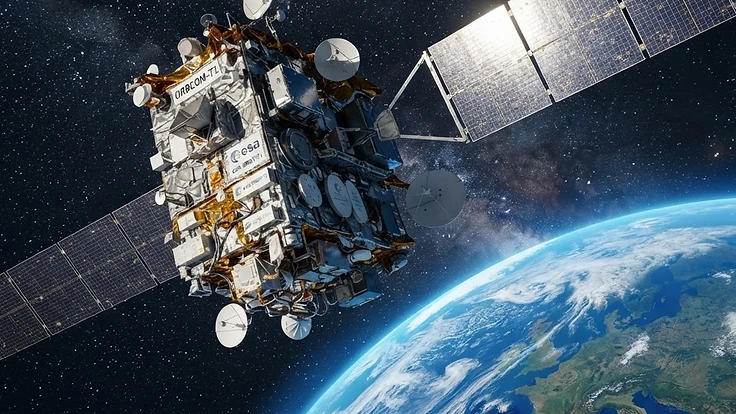
Geostationary Satellites Maintain Their Fixed Positions
High above the Earth, a vast network of satellites remains locked in place relative to the ground. These are geostationary satellites, essential components of our modern global infrastructure.
They appear motionless to observers on the surface, yet they travel at immense speeds to maintain their specific altitude. Understanding how they stay in one spot provides insight into the invisible architecture supporting our daily communications.
The Science Behind It
A geostationary orbit requires a satellite to circle the Earth at exactly the same rate that our planet rotates on its axis. This is known as a geosynchronous orbit, requiring the satellite to complete one full revolution in exactly one sidereal day.
To achieve this, the satellite must be positioned at an altitude of approximately 35,786 kilometres directly above the equator. At this precise height, the gravitational pull of the Earth is perfectly balanced by the satellite's orbital velocity.
If the satellite moved any faster, it would drift away into higher space. If it moved slower, gravity would pull it down toward the atmosphere.
Because they orbit above the equator, these satellites are permanently fixed in the sky from any single ground station's perspective. This allows for stable links for television signals and continuous weather monitoring.
Real-World Implications
Geostationary satellites serve as the backbone for global telecommunications and television broadcasting. Because the satellite does not move across the sky, ground antennas do not need tracking motors to stay connected.
This technology also powers modern meteorology. Weather satellites at this altitude capture wide-field images of the Earth, allowing scientists to track storm systems and cloud patterns over entire continents in real time.
However, these satellites are vulnerable to space weather. Intense solar activity can disrupt their delicate electronic systems or interfere with the signals they beam back to Earth.
Understanding these risks is part of a larger conversation about space safety and the impact of solar particle events on spacecraft and astronauts. Operators must constantly adjust orbits to avoid debris and mitigate the effects of radiation.
What You Can Do
You can keep track of the space environment that impacts satellite operations by using tools that monitor solar activity. You can learn to identify artificial satellites in the night sky with a basic understanding of orbital mechanics.
For those interested in the broader context of what happens above us, tracking the current K-index levels helps identify when geomagnetic conditions might interfere with satellite-based radio or GPS signals.
If you manage your own data or display, you might consider using embeddable widgets to show live solar status on your own platform. These resources provide a clearer picture of how solar flares and winds affect the invisible web of technology circling our planet.
Key Takeaways
Geostationary satellites are marvels of balance, sitting at a precise altitude where their orbital speed matches the rotation of the Earth. This fixed position is what allows them to act as constant relay points for our television, weather, and communication networks.
While they appear static, they are part of a dynamic and sometimes hazardous environment in space. Keeping an eye on the latest solar data helps us appreciate the complexity of this technology. It serves as a reminder that the stability of our modern digital lives depends on objects thousands of kilometres above our heads.
People Also Ask
Why do geostationary satellites stay over the same spot?+
They stay over the same spot because their orbital period is exactly equal to the Earth's rotation period of 23 hours, 56 minutes, and 4 seconds. By orbiting at an altitude of 35,786 kilometres above the equator, they maintain a constant relative position to the surface.
Can you see geostationary satellites with the naked eye?+
No, you cannot see them with the naked eye. Because they are located in a very high orbit over 35,000 kilometres away, they are far too small and distant to be visible without specialized, high-powered telescopes. Most satellites seen in the sky are in much lower orbits.
How does weather affect geostationary satellites?+
Severe space weather, such as solar flares or geomagnetic storms, can damage satellite electronics or corrupt data transmission. Charged particles from the sun can build up static charge on the satellite's surface, leading to arcing and potential permanent hardware failure if the craft is not properly shielded.
Continue Reading
Forecast These Questions
View all →Express your probability on these active forecast questions.
Related Articles

Satellite Operators Use Advanced Strategies to Mitigate Space Weather Risks
2026-11-10 · 5 min read

Understanding the Mechanics of Sun-Synchronous Orbits
2026-10-16 · 5 min read

Tracking the International Space Station in Real Time
2026-10-02 · 5 min read