
Photographing Satellites and Starlink Trains
Capturing satellites in orbit requires patience and the right equipment. Discover how to track, time, and shoot these elusive man-made lights as they streak across the night sky.
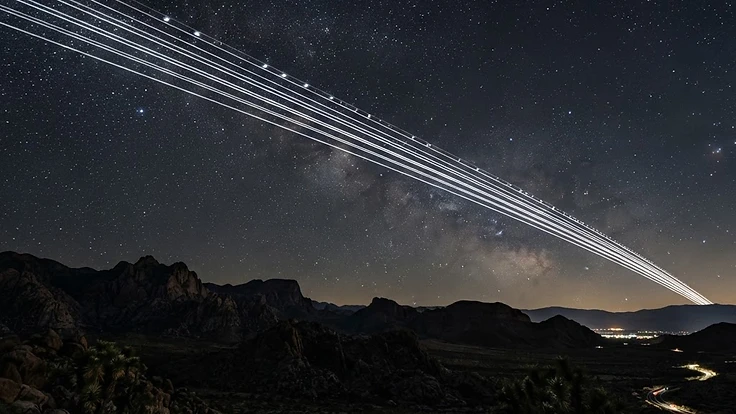
Capturing the Movement of Orbiting Satellites
The night sky is no longer a pristine canvas of natural light. Modern low Earth orbit is crowded with thousands of objects, from the International Space Station at 408 kilometres to the rapidly expanding Starlink constellations. Photographing these craft allows you to record the pace of human innovation against the static backdrop of the cosmos.
Successfully capturing a satellite, or the infamous Starlink train, demands more than just a camera and a tripod. It requires an understanding of orbital mechanics and precise timing. You must predict where these objects will appear to avoid wasting hours staring into the void of the night sky.
The Physics of Orbital Visibility
Satellites do not produce their own light. We see them only because their reflective surfaces catch sunlight while the observer on the ground is already in darkness. This is why sightings are most common shortly after sunset or just before sunrise.
Objects orbiting near the Kármán line, which marks the boundary of space at 100 kilometres, move with significant angular velocity across our field of view. Their speed depends on their altitude and orbital inclination. While they appear to drift slowly to the naked eye, a long exposure photograph will reveal their true path as a defined streak against the stars.
Real-World Implications of Orbital Density
The increasing number of satellites presents challenges for both astronomers and space agencies. As our reliance on satellite-based communication grows, so does the risk of collisions and the accumulation of space debris. Monitoring these objects is now a core aspect of space situational awareness.
Reliable data on orbital trajectories helps researchers maintain the integrity of our critical infrastructure. We must also consider how these constellations impact our ability to observe deep space. The challenge lies in balancing global connectivity with our duty to preserve the clarity of the night sky for scientific research.
What You Can Do
Preparation begins with tracking tools. Use resources like the mechanics of real time satellite tracking to identify passes over your specific coordinates. When you are ready to shoot, use a wide-angle lens and a sturdy tripod, setting your camera to a manual exposure to capture the satellite as a clean line rather than a series of dashes.
If you find yourself waiting for the skies to clear, you can check the [local aurora forecast](/aurora-forecast) to see if you have a chance to pair your satellite shots with a natural light show. For those interested in deeper celestial monitoring, our embeddable widgets allow you to keep an eye on real-time space conditions directly on your own website or blog. Always consult the glossary if you encounter technical terms that hinder your understanding of orbital parameters or solar weather.
If you'd rather leave the planning to someone else, guided aurora tours across Iceland, Norway, Canada and Finland put you under the right sky with local experts who know exactly when to head out.
Key Takeaways
Photographing satellites is a blend of technical preparation and environmental awareness. By understanding the timing of orbits and the requirements of long-exposure photography, you can produce stunning images of human technology in flight. Remember that the best shots come from planning, not just luck.
Keep track of the broader space environment, as understanding the Dst index and overall activity can influence your success. Whether you are aiming for a single pass or a full train of Starlink satellites, your persistence will eventually yield the perfect frame. The sky is busier than ever, offering endless opportunities to document our reach into the heavens.
People Also Ask
Why do satellites look like moving stars?+
Satellites reflect sunlight back to Earth, similar to the moon. Because they are in motion relative to our perspective, they appear as steady, moving points of light. They do not twinkle like stars because their light source is consistent and they are much closer to our atmosphere.
What is the best camera setting for capturing satellites?+
Use a manual mode with a wide aperture, such as f/2.8, and a low ISO to reduce noise. Set your shutter speed between 10 and 30 seconds depending on the satellite brightness. A stable tripod is essential to keep the stars sharp while the satellite streaks across the frame.
Are Starlink satellites always visible?+
No, Starlink satellites are only visible when they are in direct sunlight while the observer on the ground is in darkness. They are most commonly seen shortly after dusk or just before dawn, as they reflect the sun's rays down to your specific position on Earth.
Continue Reading
Forecast These Questions
View all →Express your probability on these active forecast questions.
Related Articles

Satellite Operators Use Advanced Strategies to Mitigate Space Weather Risks
2026-11-10 · 5 min read

Understanding the Mechanics of Sun-Synchronous Orbits
2026-10-16 · 5 min read

Tracking the International Space Station in Real Time
2026-10-02 · 5 min read