Solar Flares Influence Global Power Grid Stability
Solar flares and coronal mass ejections can interfere with ground-based infrastructure. Understanding the science behind geomagnetic disturbances is essential for modern grid reliability.
Solar Flares Influence Global Power Grid Stability
The sun is an active star that undergoes roughly 11 year cycles of magnetic activity. During these periods, solar flares and coronal mass ejections can send bursts of radiation and charged particles toward Earth.
Live Solar Flare Monitor
Powered by Flarient — embed this on your site →
While these events are natural, they can interact with our planet's magnetic field in complex ways. This has led to widespread public interest regarding whether solar activity can cause significant power outages.
The Science Behind It
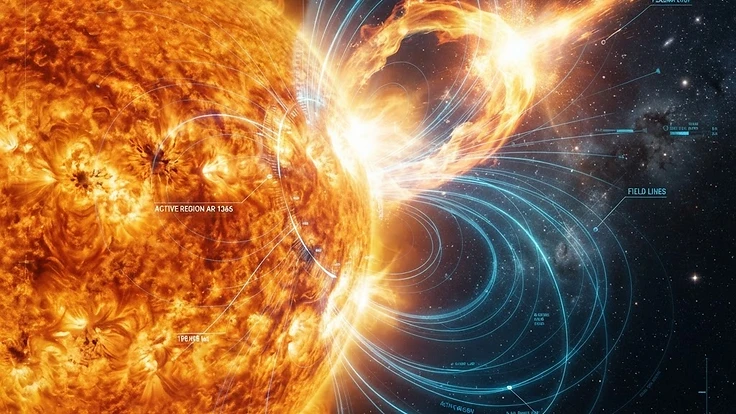
A solar flare is a sudden flash of increased brightness on the sun, usually observed near its active regions. These are classified by strength using letters, where X is the most intense, while M and C classes are increasingly common.
It is vital to distinguish these flares from coronal mass ejections. While a flare travels at the speed of light, a coronal mass ejection consists of plasma moving at hundreds or thousands of kilometres per second.
When this plasma cloud reaches Earth, it can trigger a geomagnetic storm. Scientists measure the severity of these storms using a G-scale that ranges from G1 to G5, based on how much they distort our magnetosphere.
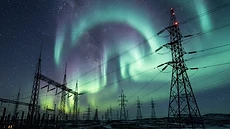
Large storms induce currents in long conducting materials, such as power lines and pipelines. These are often referred to as geomagnetically induced currents and can lead to voltage fluctuations on the electrical grid.
You can learn more about how these magnetic shifts affect our technological environment in our glossary.
Real-World Implications
Modern power grids rely on high voltage transformers that are designed for standard operating conditions. When intense currents are induced by a geomagnetic storm, they can saturate these transformers.
If the disturbance is severe enough, it can cause the protective relays to trip and shut down the flow of electricity to prevent equipment damage. In extreme cases, such as the event of 1989, this has led to major regional blackouts.
It is worth noting that space weather also impacts radio communications and satellite operations. You can find detailed analysis on this in our article How the Solar Cycle Dictates Radio Communication Conditions.
Infrastructure managers now use data from agencies like the NOAA SWPC to prepare for these disturbances.
By identifying incoming solar weather patterns, operators can adjust grid loads to mitigate potential damage.
What You Can Do
Staying informed is the first step toward understanding space weather impacts. If you are planning an expedition to see the resulting aurora, consider booking guided aurora tours in destinations like Iceland, Norway, Canada, or Alaska to ensure the best experience.
Utility companies and amateur radio operators often use embeddable widgets on their websites to monitor real time space weather data. These tools provide a clear view of current indices and potential impacts without requiring complex technical knowledge.
You can also browse the storm leaderboard to understand how current activity compares to historical events. Keeping track of the solar cycle helps you anticipate periods of heightened geomagnetic sensitivity.
Key Takeaways
Solar flares themselves are electromagnetic energy, but the resulting coronal mass ejections carry the mass that disturbs our magnetic field. These disturbances only threaten power grids when they reach high intensity on the G-scale.
Modern grid engineering has improved significantly since earlier, more vulnerable eras. By maintaining awareness of space weather through tools like the solar imagery feeds, we can better manage our technological footprint.
While space weather is a permanent feature of our solar system, it remains a manageable variable in our daily lives. Continuous monitoring ensures that our infrastructure remains resilient against the changing whims of our sun.
People Also Ask
How do solar flares damage electronics?+
Solar flares themselves are mostly radiation, but associated geomagnetic storms induce electrical currents in long wires. These surges can overwhelm sensitive electronic components or transformers, potentially causing hardware failure or triggering safety shutdowns in power distribution systems.
What is the strongest solar storm ever recorded?+
The strongest storm on record is the Carrington Event of 1859. It caused widespread telegraph failures globally and produced auroras visible in tropical regions, suggesting it would be devastating to our current electrical and satellite infrastructure.
Are satellites at risk from solar flares?+
Yes, satellites in orbit face risks from increased atmospheric drag during solar storms and damage to sensitive microelectronics. Radiation can interfere with onboard sensors and communication arrays, necessitating safe-mode operations during high-intensity solar events.
Continue Reading
Forecast These Questions
View all →Express your probability on these active forecast questions.