The Composition of the Interstellar Medium
Vast stretches of space between stars are not empty, but filled with a complex mixture of gas, dust, and cosmic rays. Discover what makes up the interstellar medium and why it is vital to the life cycle of galaxies.
The Composition of the Interstellar Medium
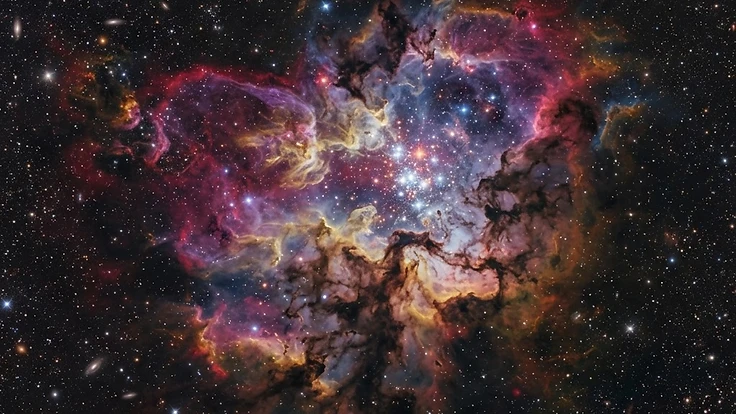
Space often appears empty to the naked eye. In reality, the vast regions between stars, known as the interstellar medium, contain a diffuse but critical cocktail of matter. This material serves as the raw ingredient for future generations of stars and planets.
Understanding the makeup of this medium is essential for astronomers mapping the evolution of our galaxy. It is not merely a collection of random atoms but a dynamic environment shaped by the birth and death of stars.
The Science Behind It
The interstellar medium is primarily composed of gas, which accounts for about ninety-nine per cent of its total mass. Hydrogen is the most abundant element, existing in both atomic and molecular forms, followed by helium and traces of heavier elements.
Dust particles, often referred to as interstellar grains, make up the remaining one per cent. These tiny solid fragments consist of silicates, carbon compounds, and ices that absorb or scatter starlight, a process we can observe using solar imagery.
Beyond gas and dust, the medium is permeated by magnetic fields and high-energy cosmic rays. These components influence the rate at which gas clouds collapse to form new stars. This interplay is a key focus of study, much like how researchers look at Sunspots and Their Role in Shaping Space Weather to understand solar cycles.
Real-World Implications
The density and temperature of the interstellar medium determine the shape and structure of our galaxy. It acts as a giant recycler, where material ejected by supernova explosions settles into clouds that eventually trigger new star formation.
This material also interacts with our own solar system. As the Sun travels through the galaxy, it clears a path through this medium, creating a boundary known as the heliopause. The density of the interstellar medium determines how much radiation and interstellar material reaches our neighbourhood.
Studying these interactions helps scientists model the long-term impact on our space environment. While we focus heavily on geomagnetic storm events caused by the Sun, the external influence of interstellar matter provides context for the broader space weather climate.
What You Can Do
You can deepen your understanding of space phenomena by monitoring the data that shapes our local environment. Using tools like embeddable widgets allows you to track current conditions, bridging the gap between deep space science and what we see from Earth.
If you are interested in the visual output of these space processes, the aurora remains the most accessible way to witness solar-interstellar interactions in real time. Observing these lights is a gateway to learning about the plasma physics that governs the wider cosmos.
For those looking for a more immersive experience, many travellers now join guided aurora tours in countries like Iceland, Norway, and Canada to better understand these displays under professional guidance. Whether you are tracking the next solar flare or simply curious about the vacuum of space, staying informed is key.
Key Takeaways
The interstellar medium is the foundation of our galactic lifecycle. It acts as a reservoir of gas and dust, waiting to be processed into stars and planetary systems. Without this diffuse material, the universe would be a far less dynamic place.
By analysing the composition and movement of this medium, scientists unlock the history of our origins. We continue to learn how these distant environments define the boundaries of our own solar system. Keeping track of space conditions remains the best way to stay connected to the active, ever-changing universe around us.
People Also Ask
How dense is the interstellar medium?+
The interstellar medium is incredibly thin. On average, it contains only about one atom per cubic centimetre. This is far more of a vacuum than anything we can create in a laboratory on Earth, yet its vast volume makes it a significant component of galactic mass.
What is an interstellar grain?+
Interstellar grains are tiny solid particles, usually between 0.01 and 0.1 micrometres in size. They are composed of silicates, carbon, and various ices. These grains are vital because they provide surfaces where chemical reactions occur, leading to the formation of more complex molecules in space.
Does the interstellar medium contain dark matter?+
While the interstellar medium is made of normal matter like gas and dust, it is embedded within a much larger halo of dark matter. Dark matter does not interact with light, but its gravitational pull is what holds the interstellar medium and the stars together within the galaxy.
Continue Reading
Forecast These Questions
View all →Express your probability on these active forecast questions.