The Discovery of Asteroid Moons and Their Celestial Systems
Binary asteroid systems are common in the solar system. Learn how small space rocks can possess their own moons and what these orbiting companions reveal about the history of our solar system.
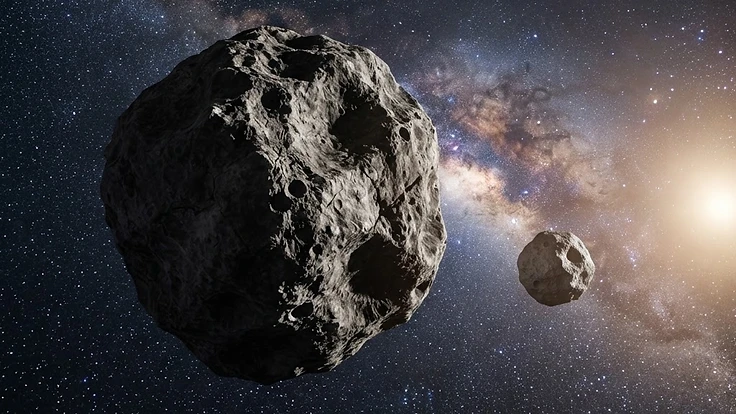
Asteroids Often Possess Their Own Moons
For decades, scientists viewed asteroids as lonely, solitary wanderers drifting through the void. We now know that many of these objects are far more complex, often travelling as part of binary systems where a smaller moon orbits a larger primary body.
Near-Earth Asteroid Watch
Powered by Flarient — embed this on your site →
This discovery has fundamentally altered our understanding of solar system evolution. By studying these tiny satellites, researchers gain insights into the structural integrity and formation history of near-Earth asteroid candidates that occasionally cross our path.
The Science Behind It
Asteroid moons typically form through a process of rotational fission or through the accumulation of debris following a larger impact. When an asteroid spins too rapidly, centrifugal force can cause it to shed material that eventually coalesces into a companion body.
These binary systems are not necessarily perfectly spherical. Their irregular shapes and low gravity make modelling their orbital dynamics a challenging endeavour for planetary scientists.
Gravitational influence from the Sun and larger planets plays a significant role in stabilising these orbits. Without the right balance of spin and material density, these moons might simply drift away or collide with the parent body, as described in The Celestial Construction of Asteroids.
Real-World Implications
Understanding these binary systems is vital for space safety and future exploration. Knowing whether an object is a single solid rock or a collection of rubble and debris orbiting a centre of mass drastically changes how we would approach a potential deflection mission.
These systems also serve as natural laboratories for high-energy physics. Observations using ground-based radar and space-based solar imagery help us map the gravitational field of these moons to better understand their composition.
This data is as critical as monitoring geomagnetic storm activity or atmospheric conditions. Just as we analyse the intensity of solar weather, we must track the physical characteristics of objects that could represent a collision risk.
What You Can Do
You do not need a professional observatory to stay informed about the objects moving through our cosmic neighbourhood. Using public data sets provided by organisations like NASA CNEOS, you can monitor the timing of a future close approach.
If you maintain a website or a personal blog, consider using embeddable widgets to display the latest data on asteroid trajectories. This allows your audience to see the activity in real time without leaving your page.
Understanding the space environment is a comprehensive task. Keeping track of asteroids is just as important as keeping an eye on solar activity through the glossary and live feeds available online.
Key Takeaways
The existence of moons orbiting asteroids proves that the solar system is a dynamic, crowded environment. These small companions are not mere curiosities, they are integral components of asteroid systems that shape our broader understanding of planetary science.
As our detection technology improves, we will undoubtedly discover thousands more of these hidden systems. Continual observation remains our best defence in learning how to interact with and protect against the remnants of the early solar system.
People Also Ask
How common are asteroid moons?+
Research indicates that roughly 15% of near-Earth asteroids larger than 200 metres in diameter are actually binary systems. This suggests that having a moon is a relatively common phenomenon among smaller bodies in our solar system rather than an anomaly.
Do asteroid moons pose an extra danger?+
Binary asteroids can be more challenging to track and predict. If an asteroid has a moon, its gravitational centre is more complex to calculate, which is a vital factor for planetary defence missions attempting to measure the object's mass and trajectory accurately.
How do scientists detect moons around asteroids?+
Scientists use light curves, which measure fluctuations in brightness as an asteroid rotates, and ground-based radar imaging to detect the presence of moons. When a moon passes in front of or behind the primary asteroid, the reflected light changes, revealing the companion's presence.
Continue Reading
Forecast These Questions
View all →Express your probability on these active forecast questions.