The Mechanics of How Asteroids Reach Earth
Asteroids shape our planet's history and future. Understanding the physics behind how these objects reach Earth is essential for modern space situational awareness.
Asteroids Reach Earth Through Complex Orbital Dynamics
Space is not empty, though it often appears so to the naked eye. It is a crowded neighbourhood where gravity acts as the primary architect of motion for every object, including the remnants of the early solar system known as asteroids.
Near-Earth Asteroid Watch
Powered by Flarient — embed this on your site →
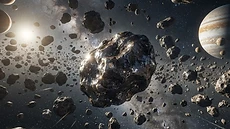
Most of these rocky bodies reside comfortably within the asteroid belt located between Mars and Jupiter. Sometimes, their stable paths are disrupted by the gravitational influence of giant planets, nudging them into orbits that intersect with our own. These objects are classified as a near-Earth asteroid when their path brings them within proximity to our orbit, transforming from distant curiosities into objects of scientific scrutiny.
The Physics of Orbital Mechanics
Gravity is the invisible hand that dictates the movement of all celestial bodies. When a large planet like Jupiter exerts a gravitational pull on an asteroid, it can alter the object's velocity and trajectory significantly.
This process is often a slow migration over millions of years, moving an asteroid from a stable zone into a chaotic path. Once an object is in a resonant orbit, repeated gravitational interactions may eventually pull it inward toward the inner solar system.
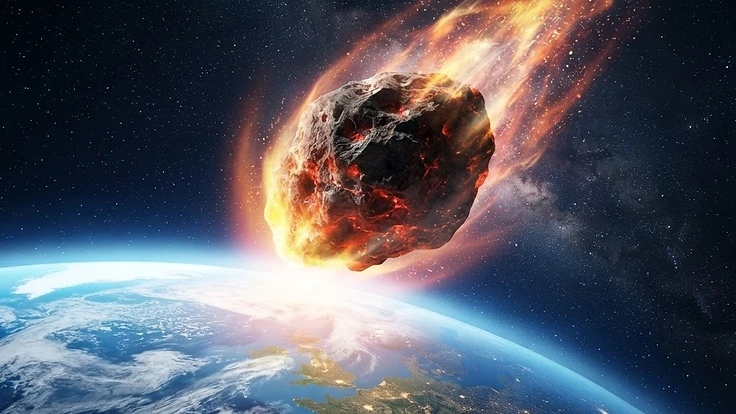
As the asteroid approaches the Earth, its speed increases due to the acceleration provided by our planet's gravitational well. If the object happens to be on a direct collision course, it will encounter our atmosphere at speeds often exceeding several kilometres per second.
The intense friction of the air acts as a natural shield, generating extreme heat and pressure on the leading surface of the object. While many small rocks burn up entirely as meteors, larger bodies can retain enough mass to strike the surface, creating an impact crater.
Real-World Implications for Global Safety
Historically, major impacts have altered the climate and biological trajectory of our planet. The Chicxulub event, which occurred approximately 66 million years ago, involved an object roughly 10 kilometres wide that released energy equivalent to billions of tonnes of TNT.
While such catastrophic events are rare on a human timescale, the constant presence of space debris requires consistent monitoring. Modern infrastructure, including critical satellite constellations, remains vulnerable to debris clouds, though the primary concern remains the identification of large objects.
Understanding these threats is a core component of planetary defence strategies developed by international space agencies. You can learn more about how scientists identify such threats by reading our analysis on identifying asteroids that pose a threat to Earth.
What You Can Do to Monitor Near-Earth Objects
Staying informed is the most effective way to understand the dynamic environment of our solar system. You do not need to be an astronomer to track the status of space, as several tools offer transparent access to orbital data.
We recommend using our [near-Earth asteroid](/ #asteroids) tracking features to view live data and upcoming close approaches. By monitoring these datasets, you gain a clearer picture of how objects pass by our planet on a regular basis.
If you manage a space-related website, you can easily embeddable widgets to display real-time tracking data for your audience. This helps in educating the public about the frequency and nature of these orbital events without relying on speculation.
Key Takeaways
Asteroids reach Earth primarily through gravitational perturbations caused by larger planets, which shift their orbits over vast timescales. While the threat of a major impact is statistically low, it remains a focal point for global scientific monitoring efforts.
By leveraging modern observational data and staying curious about orbital mechanics, we move from fear to factual understanding. You can delve further into the complexities of our space environment by browsing our glossary for essential scientific definitions.
People Also Ask
How often do large asteroids hit Earth?+
Large asteroid impacts are extremely rare. The most significant impacts occur on timescales of millions of years. Smaller objects, which burn up in the atmosphere as meteors, enter Earth's atmosphere much more frequently, often on a daily basis, but they rarely reach the surface with significant mass.
Can we stop an asteroid from hitting Earth?+
Yes, NASA and other space agencies are developing planetary defence strategies. The most prominent method involves kinetic impactors, where a spacecraft is intentionally crashed into an asteroid to slightly alter its velocity, changing its trajectory enough to ensure it misses Earth entirely if identified early enough.
How do scientists find asteroids?+
Astronomers use ground-based telescopes and space-based infrared observatories to scan the sky. By comparing images taken at different times, they can identify objects that have moved against the background of stationary stars, allowing them to calculate precise orbital paths using advanced mathematical modelling and observation.
Continue Reading
Forecast These Questions
View all →Express your probability on these active forecast questions.