Understanding the Sunspot Cycle and Its Influence on Earth
The solar cycle governs the Sun's magnetic behaviour, dictating space weather that impacts technology and natural phenomena on Earth. Learn how this 11-year rhythm shapes our connection to the star at the centre of our system.
The Sunspot Cycle Governs Solar Activity
The Sun is not a static ball of fire, but a dynamic, magnetic engine that fluctuates over time. At the heart of this engine is the solar cycle, an approximately 11-year period during which solar activity rises and falls.
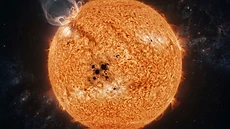
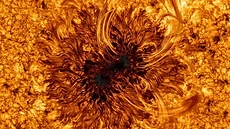
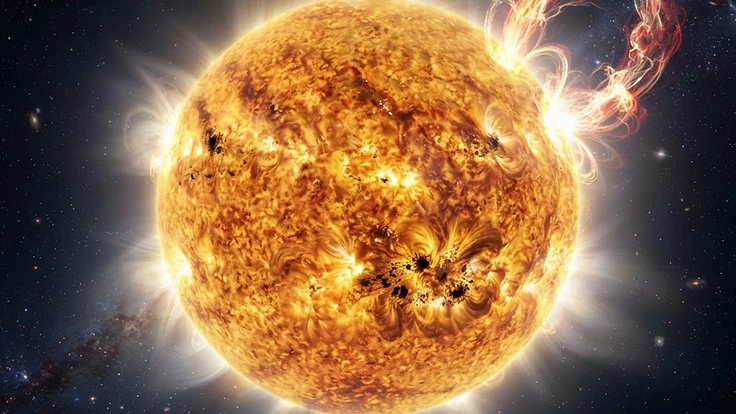
Observers track this rhythm by counting sunspots, which are temporary, cooler regions on the solar surface. As we move from a solar minimum to a maximum, the number of these dark, magnetically active spots increases, signalling a period of heightened solar output.
The Science Behind It
The solar cycle is driven by the internal movement of plasma deep within the Sun. As the Sun rotates, its differential speed at the equator versus the poles twists its internal magnetic field, creating immense tension.
This magnetic energy periodically snaps and reconnects, releasing massive amounts of radiation and charged particles. These events, ranging from solar flares to coronal mass ejections, can significantly distort the local space environment.
Solar activity is categorised by the strength of these outbursts, with flares labelled from A to X. An X-class flare is ten times more powerful than an M-class, showcasing the extreme scale of these solar events.
These particles travel through the solar system, sometimes reaching Earth within days. When they strike our magnetic field, they cause a geomagnetic storm that can be measured using the Kp index or the Dst index for intensity.
Real-World Implications
Increased solar activity directly affects our modern technological infrastructure. Satellites orbiting in the thermosphere can experience increased drag, potentially altering their trajectories, as discussed in our piece on tracking satellites across the night sky.
Power grids on the ground may also face induced electrical currents during intense storms. This is why power grid operators maintain constant vigilance, tracking data in the storm leaderboard to monitor the strongest events on record.
Communications are equally sensitive, particularly those relying on high-frequency radio waves. Solar interference can disrupt signal propagation, making tools that analyse these conditions essential for amateur radio operators.
What You Can Do
Staying informed about space weather requires a combination of observation and data analysis. You can explore solar imagery from orbiting observatories to see the Sun as it looks today.
If you are interested in witnessing the atmospheric consequences of solar activity, our [local aurora forecast](/aurora-forecast) helps you determine if the auroral oval is dipping far enough south for you to see. For those seeking the best displays, we suggest booking guided aurora tours in countries such as Iceland, Norway, Finland, or Canada, where local experts can take you away from light pollution.
If you operate a website or blog, you can even embed on your site live data feeds to keep your visitors updated. It is a simple way to bring real-time space weather information to your own community.
Key Takeaways
The solar cycle is a predictable yet powerful rhythm that defines our space weather environment. While it can pose challenges for satellites and power grids, it also creates the stunning displays of light we recognise as the aurora.
Understanding the Sun helps us protect the technology that defines our interconnected lives. Whether you are an amateur observer or simply curious, keeping track of solar progress ensures you never miss the next major event. You can learn more by checking our extensive glossary of terms to deepen your understanding of these celestial mechanics.
Observation note
Sunspot cycles are measured through changes visible on the solar surface, giving readers a practical way to connect long term activity with direct observation. For those interested in documenting sunspots safely, explore an observation setup suited to capturing the changing appearance of the sky.
Ad · Affiliate link. Flarient may earn a commission if you purchase through this link, at no additional cost to you.
People Also Ask
Can solar flares reach Earth?+
Yes, solar flares and coronal mass ejections can reach Earth. While the light from a flare arrives in about eight minutes, the charged particles of a coronal mass ejection typically take one to three days to traverse the distance from the Sun to our planet's magnetosphere.
What happens during a G5 geomagnetic storm?+
A G5 storm is the highest level of geomagnetic disturbance on the G-scale. It can cause major power grid failures, complete high-frequency radio blackouts on the sunlit side of Earth, and force satellite operators to manually manage their spacecraft to prevent loss of control.
Does the solar cycle affect Earth's climate?+
The solar cycle has a minor influence on Earth's climate compared to other factors. While the total solar irradiance changes slightly over the 11-year cycle, the effect on global temperatures is minimal and does not drive long-term climate trends like human-induced greenhouse gas emissions do.
Continue Reading
Forecast These Questions
View all →Express your probability on these active forecast questions.