
How Ionospheric Storms Impact GPS Accuracy
Ionospheric storms disrupt satellite signals by altering the path of radio waves. Learn how space weather affects GPS precision and what you can do to stay informed.
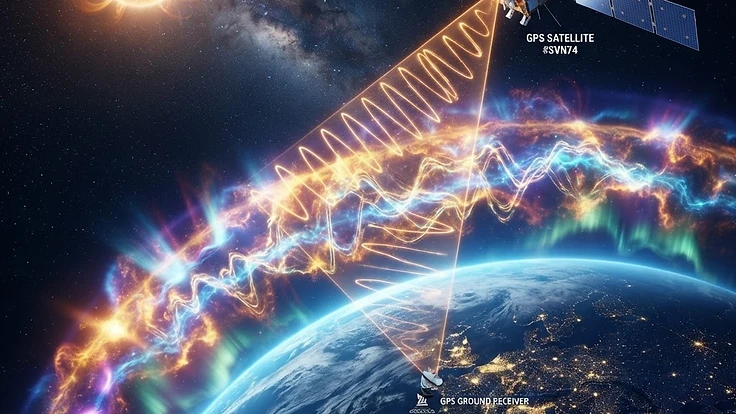
Ionospheric Storms Disrupt Global Positioning Systems
Modern society relies on Global Positioning Systems to navigate the world. Whether you are driving a car, flying an aircraft, or managing a shipping fleet, timing and location data must remain precise. Most users assume these signals are constant, but the ionosphere can create significant interference.
Solar activity drives these atmospheric changes, often resulting in measurement errors. When the sun enters an active phase, it sends particles towards Earth that interact with our magnetic field. Understanding how these events distort signals is essential for any professional relying on satellite navigation.
The Science Behind It
GPS satellites orbit at altitudes of about 20,000 kilometres, sending radio signals down to Earth. These signals must travel through the ionosphere, a layer of the atmosphere filled with charged particles and ions. The density of this layer is not uniform and changes based on solar radiation.
When a geomagnetic storm occurs, the solar wind hits the magnetosphere and causes intense fluctuations in ionisation levels. This creates patches of uneven density that cause GPS signals to refract, or bend, as they pass through. Because the signal velocity changes based on the electron content, the calculated time of travel becomes inaccurate.
Since GPS relies on the speed of light to calculate distance, a delay of even a few nanoseconds leads to a positional error of several metres. Severe events can cause signal scintillation, where the waves bounce or scatter uncontrollably. You can explore how these solar events are measured by learning about the Dst index to better grasp the severity of such disturbances.
Real-World Implications
For the average smartphone user, ionospheric interference might result in a blue dot shifting slightly on a digital map. However, for industries like precision agriculture and aviation, the consequences are far more serious. Machines that steer themselves using satellite guidance may lose their track or halt operations entirely.
Power grids and telecommunications infrastructure also face risks during these periods of high solar activity. You can read more about the broader effects of these events in our article on how geomagnetic storms impact global power grids.
Aviation systems rely on consistent signal integrity to maintain safety corridors, and outages force crews to switch to backup navigation methods.
Surveyors and engineers working on large-scale infrastructure projects often find their work stalled during high-activity periods. If their equipment cannot resolve the signal correctly, measurements for roads or buildings become unreliable. Even offshore drilling platforms and maritime vessels face challenges when navigation data loses its sub-metre accuracy.
What You Can Do
Preparedness begins with monitoring current conditions. Using a [local aurora forecast](/#local) helps you understand if your region is experiencing the atmospheric conditions that usually precede signal interference. By tracking the activity level, you can anticipate potential service delays in your professional or recreational activities.
If you own a website or application that serves professionals, you can use our embeddable widgets to provide real-time updates directly to your users. Keeping track of the data allows you to make informed decisions about when to schedule critical tasks that rely on high-precision GPS. You might also look into essential consumer devices designed to provide alerts when solar activity increases.
For those interested in the natural phenomena associated with these storms, guided aurora tours in countries like Iceland, Norway, Canada, and Finland offer a chance to witness the atmosphere in action. These tours provide unique insights into the northern lights, which are often the most visible manifestation of the energy disrupting our GPS signals.
Education and preparation remain the best tools for mitigating the risks associated with a dynamic solar environment.
Key Takeaways
Ionospheric storms represent a complex hurdle for satellite navigation systems by changing the medium through which signals travel. While the sun drives these variations, modern technology allows us to monitor, predict, and mitigate the resulting errors. Understanding these cycles helps users manage expectations when using GPS for critical work.
Staying informed about solar activity ensures you are never caught off guard when navigation accuracy dips. By leveraging real-time data and maintaining awareness of space weather, we can safely navigate both our digital and physical worlds. Keep an eye on our latest data to stay prepared for whatever the sun sends our way.
People Also Ask
Can GPS work during a solar storm?+
Yes, GPS generally continues to function during a solar storm, but precision is often significantly reduced. You may experience signal drift or loss of lock, making the system unreliable for tasks requiring high-precision positioning like surveying or automated machinery until the ionospheric disturbance subsides.
How long do ionospheric storms last?+
Ionospheric storms typically last from several hours to a few days. The duration depends on the speed and magnetic orientation of the solar wind or coronal mass ejection hitting Earth. Minor storms may resolve quickly, while severe geomagnetic events can cause lingering atmospheric disruptions for several days.
Does cloud cover affect GPS accuracy?+
Unlike ionospheric storms, standard cloud cover does not significantly interfere with GPS signals. Radio waves from satellites can easily pass through clouds and rain. However, severe atmospheric conditions like heavy, ionised particles from solar storms cause much greater signal delay than typical weather phenomena.
Continue Reading
Forecast These Questions
View all →Express your probability on these active forecast questions.
Related Articles

Understanding Ionospheric Disturbances During Geomagnetic Storms
2026-11-08 · 5 min read

Ionospheric Disturbances Pose Risks to Drone Operations
2026-09-30 · 5 min read

Ionospheric Disturbances Pose Risks to Modern Drone Operations
2026-08-31 · 6 min read