The Mechanics of Noctilucent Cloud Formation
Noctilucent clouds are ethereal, glowing features of the upper atmosphere. Discover the specific environmental conditions required for these ice crystals to form at the edge of space.
Noctilucent Clouds Form Due to Specific Atmospheric Conditions
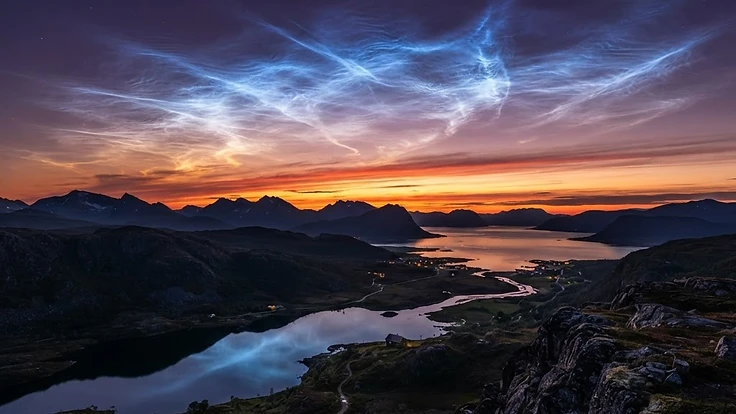
Noctilucent clouds represent one of the most striking visual phenomena in the upper atmosphere. Often referred to as night shining clouds, these delicate, electric blue ripples appear long after the sun has dipped below the horizon, illuminating the twilight sky with an otherworldly glow.
While they may seem like simple atmospheric mist, their existence requires a precise balance of temperature, moisture, and dust particles. Understanding how they form provides a window into the complex dynamics of the mesosphere, a region of our atmosphere that remains difficult to study directly.
The Science Behind It
These clouds form at altitudes of approximately 80 to 85 kilometres, well above the reach of standard weather systems. This layer is known as the mesopause, and it is the coldest part of Earth's atmosphere.
For these clouds to manifest, temperatures must drop below negative 120 degrees Celsius. This extreme cooling allows rare water vapour molecules to condense into ice crystals, which is the primary component of the clouds.
In addition to extreme cold and water vapour, the clouds require a physical surface to coalesce around. Scientific consensus points to micrometeoroid dust, or meteoric smoke, as the necessary nuclei for ice crystal growth.
These tiny particles originate from space debris burning up upon atmospheric entry. As these particles settle into the upper reaches of our atmosphere, they act as the scaffolds upon which ice forms during the peak of the summer season.
Real-World Implications
Studying these clouds is not just for the benefit of skywatchers and enthusiasts. They serve as sensitive indicators of changes in the upper atmosphere, reflecting shifts in chemical composition and global climate patterns.
Because they form in such a thin, fragile layer, they are highly sensitive to disturbances. Changes in the concentration of greenhouse gases or solar activity can alter the temperature and moisture profiles of the mesopause, affecting how often these clouds appear.
Monitoring these patterns helps researchers understand long-term trends in the middle atmosphere. Just as scientists track the Earth magnetosphere to safeguard our technological reliance, tracking noctilucent clouds offers vital data for atmospheric science.
They also provide a reminder of how interconnected our planet is with the broader solar system. From the meteoric dust that falls from space to the solar flares that occasionally influence atmospheric temperature, these clouds are a testament to that relationship.
What You Can Do
If you hope to spot these phenomena, you must be observant and patient during the summer months. They are most visible at high latitudes when the sun is between 6 and 16 degrees below the horizon.
Photography enthusiasts should consult the top camera equipment for capturing noctilucent clouds to ensure they are prepared for the low-light conditions. Clear skies and a low northern or southern horizon are essential for a successful observation.
You can keep track of general atmospheric conditions using various tools, such as the resources found in our glossary for defining specific terms. Keeping an eye on broader space weather data helps in understanding the environment surrounding our planet.
Key Takeaways
Noctilucent clouds are a unique bridge between space and our atmosphere. Their formation relies on the rare combination of high-altitude moisture, sub-zero temperatures, and meteoric dust.
By observing these glowing displays, we gain deeper insight into the workings of our mesosphere. Continued study and appreciation for these clouds remind us of the beauty found in the most inaccessible reaches of our world.
People Also Ask
At what altitude do noctilucent clouds form?+
Noctilucent clouds form in the mesosphere, specifically at altitudes between 80 and 85 kilometres. This region, known as the mesopause, is the coldest layer of Earth's atmosphere, which is a necessary condition for water vapour to freeze into the ice crystals that make up these clouds.
Why are noctilucent clouds only visible at night?+
These clouds are only visible when the sun is below the horizon because they are located so high in the atmosphere that they remain illuminated by sunlight. During the day, they are too thin to be seen against the bright sky, but at twilight, they stand out against the darkness.
Are noctilucent clouds becoming more frequent?+
Scientists have observed an increase in the frequency and brightness of noctilucent clouds in recent decades. This is often attributed to the rise of methane emissions in the atmosphere, as methane breaks down into water vapour in the upper atmosphere, providing more moisture for cloud formation.
Continue Reading
Forecast These Questions
View all →Express your probability on these active forecast questions.