The Orbital Consequences of Satellite Collisions
When satellites collide in space, they create clouds of high-speed debris that threaten the safety of future missions and Earth's critical orbital infrastructure.
The Consequences of Orbital Collisions
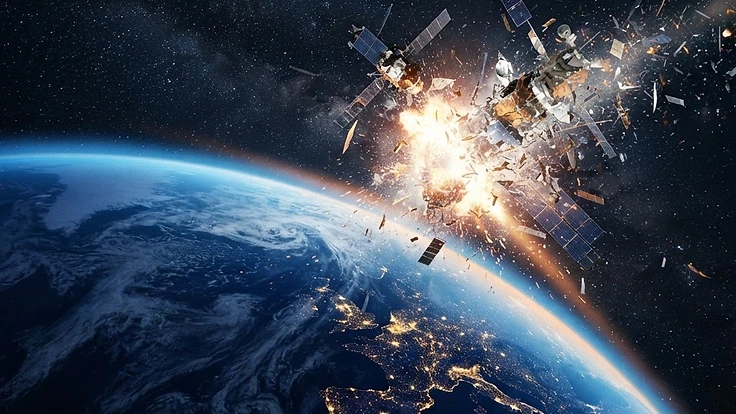
Low Earth orbit is becoming increasingly crowded with thousands of operational satellites, spent rocket stages, and fragmented debris. When two objects collide at orbital velocities, the result is not a simple dent but a violent fragmentation event that showers the immediate area with thousands of lethal projectiles. These fragments move at speeds of several kilometres per second, turning even a fleck of paint into a dangerous bullet that can pierce the hull of the ISS at ~408 km altitude.
Such a collision triggers a chain reaction known as The Kessler Syndrome and the Future of Earth Orbit. This theoretical cascade suggests that one collision produces enough debris to increase the likelihood of further impacts, potentially rendering certain orbital bands unusable for generations. Our reliance on these altitudes for communications, navigation, and global monitoring makes this a critical issue for modern society.
The Science Behind It
Objects in orbit maintain extreme speeds to counteract gravity, often travelling at approximately 7 to 8 kilometres per second. When a collision occurs, the kinetic energy released is immense because energy scales with the square of the velocity. Even a small collision releases enough energy to shatter spacecraft into thousands of trackable pieces and millions of smaller, untraceable fragments.
This process creates a self-sustaining belt of debris that stays in orbit for years or decades, depending on the altitude. Satellites at lower altitudes might eventually de-orbit due to atmospheric drag, but those in higher orbits remain as long-term hazards. Experts often refer to the glossary to define the specific debris environments we face today.
Unlike Earth, there is no weather or ocean currents to naturally sweep this orbital clutter away.
Real-World Implications
Modern life relies on satellite networks for everything from banking transactions to weather forecasting. A significant debris cloud threatens to blind these systems or destroy the hardware we take for granted. This risk is compounded by solar activity, which can expand the atmosphere, increase drag, and alter the orbits of both active satellites and debris.
Monitoring these threats is a central part of monitoring solar storms to protect satellite infrastructure. When the [Kp](/ #kp) index rises due to intense space weather, the orbital environment becomes even more dynamic and harder to predict. A major collision event would not just affect a single operator, it would disrupt the global flow of information that drives the digital economy.
What You Can Do
Individuals can play a part in promoting space sustainability by staying informed and supporting orbital stewardship initiatives. Understanding the aerospace engineering defined and explored concepts helps frame why we must track and mitigate space waste. Keeping an eye on the environment above is an act of responsible citizenship in a space-faring age.
For those interested in how these objects interact with the broader environment, check the [local aurora forecast](/ #local) to see how solar activity links to the upper reaches of our atmosphere. Knowledge of the orbital environment helps contextualise why we must be careful with our activities above the Kármán line. Being an informed observer is the first step toward advocating for safer space practices.
For travellers who want expertise over guesswork, guided Northern Lights excursions in Sweden, Scotland and Alaska pair you with photographers who read the aurora oval in real time.
Key Takeaways
Satellite collisions are not just isolated accidents, they are systemic threats that could lock us into a cycle of debris for decades. Each event adds to the collective risk for every nation operating in space, making debris mitigation a global necessity. We must balance our technological ambitions with a commitment to maintaining a clear path to orbit.
As our dependence on space systems grows, so does the urgency to manage the orbital environment. By understanding the physics and the consequences of these collisions, we can better support policies and technologies aimed at keeping space accessible for the future. Protecting our infrastructure today ensures that we can continue to explore and monitor our world from above.
People Also Ask
How often do satellites collide?+
While major, trackable satellite collisions are rare, they are increasing as the number of objects in orbit grows. Thousands of near-misses occur every year, and tracking agencies must constantly adjust satellite paths to avoid catastrophic impacts that could generate hazardous debris clouds.
What is the Kessler Syndrome?+
The Kessler Syndrome is a scenario where the density of objects in low Earth orbit becomes so high that collisions between objects cause a cascade. Each collision creates more debris, which increases the probability of further collisions, potentially making the orbit unusable for future satellites.
Can we clean up space debris?+
Engineers are currently developing active debris removal technologies, including robotic arms, nets, and harpoons designed to capture defunct satellites and de-orbit them. These methods aim to burn up the debris in Earth's atmosphere, reducing the long-term collision risk for operational spacecraft.
Continue Reading
Forecast These Questions
View all →Express your probability on these active forecast questions.