
The Van Allen Radiation Belts and Their Impact on Satellite Operations
The Van Allen belts act as a natural, invisible trap for high-energy particles surrounding Earth, posing constant challenges to satellite durability and orbital health.
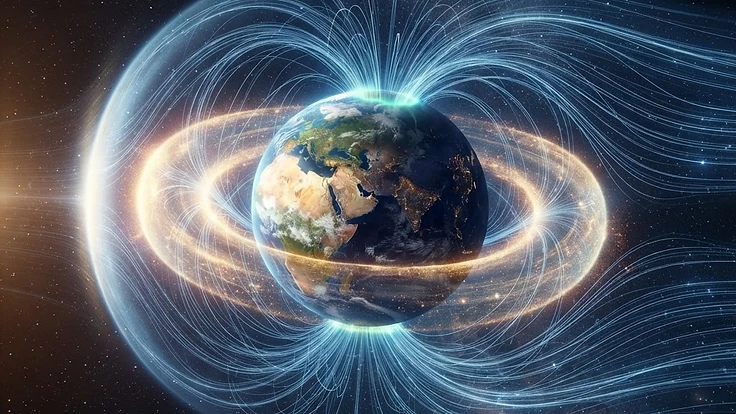
The Van Allen Radiation Belts Are Dynamic Zones of Charged Particles
Earth is surrounded by two doughnut shaped regions of trapped charged particles known as the Van Allen radiation belts. These zones are held in place by our planet's magnetic field, which acts as a protective shield against the constant bombardment of solar wind. While these belts are a natural feature of the magnetosphere, they present a challenging environment for anything we place in orbit.
Scientists classify these regions into the inner and outer belts. The inner belt is largely composed of high energy protons, while the outer belt is dominated by electrons. These particles are not static, as their intensity fluctuates significantly based on solar activity.
Understanding this complex environment is essential for anyone interested in the science of how we protect modern technology from solar particle events pose risks to spacecraft and astronauts.
The Science Behind It
Radiation belts exist because Earth's magnetic field acts like a bottle for charged particles. When solar wind or cosmic rays approach, the magnetic field forces these particles into spiralling motions along magnetic field lines. This mechanism traps high energy electrons and protons, creating zones of intense radiation that can persist for long periods.
The inner belt typically sits between 1,000 and 12,000 kilometres in altitude, while the outer belt extends much further out, sometimes reaching 60,000 kilometres. The intensity of these belts is heavily influenced by the [K-index](/ #kp), which measures geomagnetic disturbances. When a strong geomagnetic storm occurs, the injection of fresh particles into these belts can cause rapid, sometimes dangerous increases in radiation levels.
Real-World Implications
For satellites, the Van Allen belts are a hostile neighbourhood. Electronics are particularly vulnerable to high energy particle strikes, which can cause bit flips in computer memory or permanent damage to solar panels and sensors. These impacts represent a significant engineering hurdle for anyone involved in tracking satellites in real time.
Satellites in low Earth orbit often travel beneath the belts, though they may still pass through the South Atlantic Anomaly, a region where the inner belt dips closer to the surface. Satellites in higher, geosynchronous orbits must pass through the outer belt to reach their destinations, often requiring heavy shielding or hardened electronics to survive. Without proper modelling of these belts, our global communication and navigation networks would be far more prone to unexpected outages.
What You Can Do
Staying informed about the current state of Earth's magnetosphere helps in understanding why certain orbital anomalies occur. You can monitor the current space weather conditions by checking live data, which provides context for how solar activity influences the environment near Earth. If you are fascinated by the visual side of these magnetic interactions, you can explore the [aurora](/ #aurora) that often accompanies intense geomagnetic activity.
For those planning travel to high latitudes for [guided aurora tours](/https://vi.me/HuXHi) in countries like Iceland, Norway, Canada, Finland, Sweden, or Alaska, checking the forecast is essential. Using embeddable widgets allows you to keep track of these conditions and share data directly on your own platforms.
These tools transform complex telemetry into accessible information for researchers and enthusiasts alike.
Key Takeaways
The Van Allen belts remain a critical boundary in our exploration and use of space. They are not merely static zones, but living, shifting environments that respond to every fluctuation in solar output. By understanding their structure and the risks they pose to our orbital hardware, we can design more resilient systems for the future.
As we continue to launch more assets into orbit, our reliance on accurate space weather monitoring will only grow. Whether studying sunspots and their role in shaping space weather or tracking the impact of flares, the belts are an ever present factor in our technological resilience. Awareness of these invisible regions is the first step toward safeguarding our space based future.
People Also Ask
Can humans survive in the Van Allen belts?+
Humans cannot survive prolonged exposure to the Van Allen belts without heavy shielding. The high energy radiation would cause severe acute radiation sickness very quickly. NASA missions must carefully time their trajectories to minimise time spent within these zones to ensure the safety of astronauts aboard spacecraft.
How do satellites protect themselves from radiation?+
Satellites use several methods to mitigate radiation damage, including aluminium shielding, radiation hardened electronic components, and redundant computer systems. Engineers also design orbits to avoid the most intense parts of the belts when possible, and satellites may enter a safe mode during periods of extreme solar activity.
Do the Van Allen belts change size?+
Yes, the Van Allen belts are highly dynamic. Their shape, density, and energy levels change significantly in response to solar wind conditions and geomagnetic storms. During intense solar events, the belts can be compressed, expanded, or even develop a temporary third belt, depending on the influx of solar particles.
Continue Reading
Forecast These Questions
View all →Express your probability on these active forecast questions.
Related Articles


Satellite Operators Use Advanced Strategies to Mitigate Space Weather Risks
2026-11-10 · 5 min read

Understanding the Mechanics of Sun-Synchronous Orbits
2026-10-16 · 5 min read


Tracking the International Space Station in Real Time
2026-10-02 · 5 min read